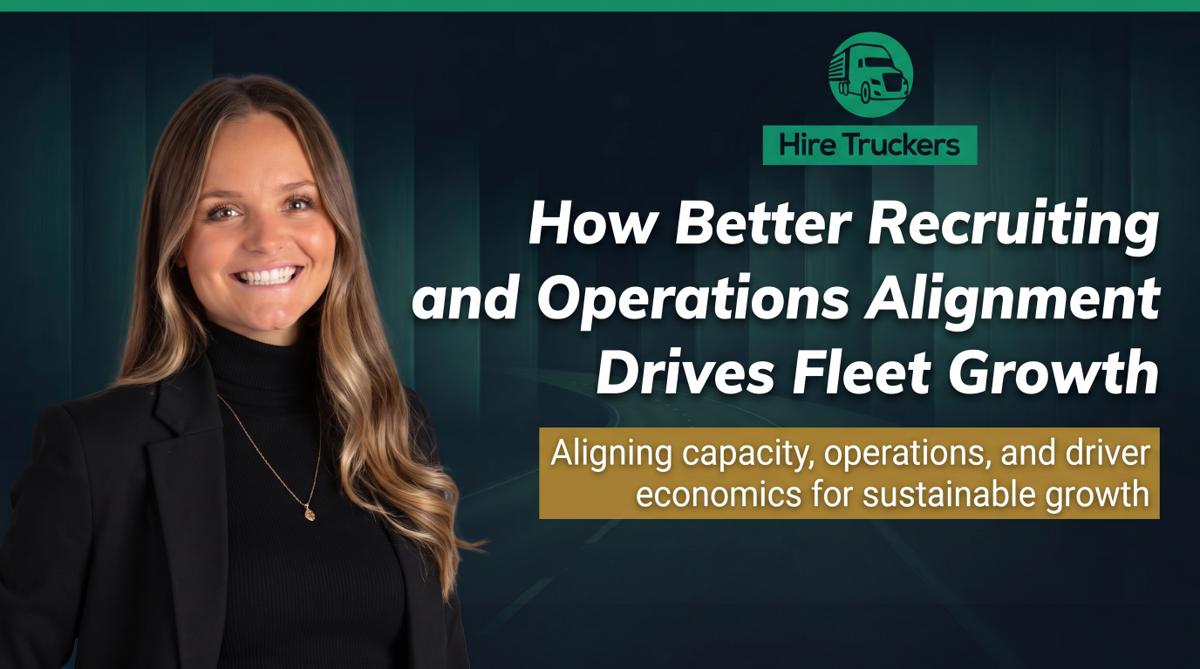
Driver recruitment often feels like a delicate dance. On one side, operations teams need trucks seated in specific lanes to move customer freight. On the other side, professional drivers and owner-operators need compensation and miles that make financial sense for their livelihoods. When those two realities do not sync, carrier profitability drops, recruiter burnout climbs, and turnover spikes.
In a recent episode of the Hire Truckers podcast, host Ginger Craddock sat down with Rachel Swanson, who leads capacity development at Forward Air. Drawing on a decade of experience across recruitment marketing, operations, and driver processing, Swanson explained why building sustainable fleet capacity requires far more than buying leads. It demands clear communication between departments, a relentless focus on lead quality, and an honest appreciation of driver economics.
The Cost of Siloed Departments
Too often in trucking, operations identifies a capacity shortfall only after loads start backing up. By the time leadership turns to the recruiting department and says, “We need 50 more seated trucks,” the fleet is already behind the curve.
Swanson emphasizes that waiting until freight peaks forces marketing and recruitment teams into a chaotic catch-up mode. When every carrier in a freight market rushes to buy advertising at the same time, cost-per-click surges and recruiting pipelines get flooded with low-intent inquiries.
“Recruiting needs to be involved as early as possible in our process. If you wait, you are just riding a wave and playing catch-up, and that is a lot harder for a recruiting team than being on the forefront.”
When operations shares forecasting data weeks ahead of schedule, recruitment marketing teams can test keywords, build targeted digital campaigns, and qualify drivers long before the loads arrive. Early alignment prevents expensive spot-market brokering and spares recruiters the frustration of chasing unachievable quotas under artificial deadlines.
Redefining Quality: The Cost Per Approval
Recruiting departments frequently get trapped in a quantity mindset. Marketing vendors boast about low cost-per-lead figures, delivering hundreds of names to recruiters who then spend their workdays dialing disconnected numbers or speaking with disqualified applicants.
Swanson challenges leaders to measure what truly matters. Instead of obsessing over cost-per-lead or even final cost-per-hire, she looks at the cost per approval.
“For the last 10 years, I have preached that I wanted quality over quantity. Everyone chases that cost per lead and looks at their final cost per hire. But one of the biggest things they miss is that cost per approval. At the end of the day, that is how I judge quality: an approved lead.”
An approved lead represents a vetted driver who submitted a complete application, passed background checks, meets safety criteria, and has built genuine rapport with a recruiter. Focusing on approvals gives recruiters the bandwidth to have authentic, unhurried conversations about pay, home time, and lane requirements. If a driver is not the right match for a company's freight network, discovering that during the first interview saves thousands of dollars down the road.
The True Financial Ripple of a Mismatched Driver
When pressure builds to seat empty trucks, carriers sometimes gloss over minor mismatches between what the driver needs and what the operation actually provides. The downstream expense of those poor fits is staggering.
The financial impact stretches well beyond ad spend and job boards:
Administrative processing costs: Running motor vehicle records, safety performance histories, drug screenings, and employment verifications.
Travel and orientation: Hotel rooms, meals, travel stipends, and trainer salaries.
The driver's investment: Owner-operators often spend between $10,000 and $12,000 in transitional downtime, fuel, and deferred maintenance when switching carriers.
Operational friction: No-shows on class day leave dispatchers scrambling to cover freight with expensive third-party brokerage.
If an onboarding driver realizes within their first month that the promised miles or regional routes are unrealistic, they leave. The fleet eats the processing and travel costs, and the seat is vacant once again.
The Misleading Nature of Raw Hire Counts
One of the most dangerous traps for carrier leadership is celebrating high hiring figures without tracking net fleet growth. If a department brings on 40 drivers in a month but loses 42 drivers in that same period, the fleet is actively shrinking despite substantial recruiting expenditures.
Swanson points out that across the broader trucking sector, drivers with around two and a half years of tenure are increasingly making lateral moves. When tenured drivers exit while new hires fail to stick, the problem rarely lies in advertising. It signals a gap between what was promised during recruiting and what dispatch delivers day to day.
Treating drivers as business partners, rather than interchangeable cogs, helps patch those leaks. Owner-operators especially are balancing escalating costs for insurance, equipment maintenance, and fuel. When carriers offer transparent pay structures and functional support programs, drivers stay put.
“Independent contractors are actually very committed. It is their business. Just as everybody else runs a business and wants it profitable, so does a driver. They have to make good business decisions.”
Where Technology Helps and Where It Stops
With artificial intelligence dominating industry conversations, many fleets look to automation as a silver bullet for capacity challenges. While automated tools excel at routine administrative tasks, such as triggering appointment confirmations or pre-screening basic application criteria, they cannot close a candidate.
Truck driving remains an intensely human profession. Drivers spend long stretches away from home, managing heavy machinery under demanding conditions. They need to know that someone at the home terminal has their back. An automated text message cannot build the trust required to help a driver transition their career or take on the financial risk of a new lane.
Carriers that succeed long-term use technology to clear away paperwork hurdles, freeing up recruiters and fleet managers to build authentic relationships that preserve retention over 30, 60, and 90 days.
How to Build Better Capacity Today
For fleet executives eager to improve their hiring efficiency and bridge internal disconnects, Swanson suggests starting with a thorough audit of your internal tool belt:
Bring recruiting into operational planning early: Share freight forecasts and seasonal volume trends with talent acquisition teams 4 to 8 weeks ahead of time.
Audit your recruiting data for blind spots: Look at disposition reasons and disqualification trends. If qualified candidates are walking away over specific route patterns or pay structures, pass that intelligence directly to your commercial strategy team.
Evaluate your recruiters on approvals, not raw lead touches: Allow recruiters the time to dig deep into a driver's career goals rather than rushing through an arbitrary call quota.
Equip your teams with clear lane specifics: Ensure your recruiters know the who, what, when, where, and why of every open seat before they pick up the phone.
Recruiting and operations are two sides of the exact same coin. When leaders unite marketing precision, transparent recruiting, and reliable dispatch execution, sustainable fleet growth becomes a predictable reality rather than an endless chase.
This article was adapted from an interview with Rachel Swanson on the Hire Truckers podcast, hosted by Ginger W. Craddock.





 Daniel Kelly